Déclaration intersyndicale lors de la réunion du 19 septembre sur le télétravail (fichier PDF)
Prochain rendez-vous avec Slawomir Krupa
Après l’annonce de Slawomir Krupa, faite par mail le 19 juin, d’un retour à un jour maximum de télétravail par semaine et la dénonciation unilatérale de la direction le 4 juillet de l’accord de janvier 2021 : L’intersyndicale CFDT, CFTC et CGT n’a eu de cesse de dénoncer à son tour la méthode brutale et méprisante à l’égard de l’ensemble des salariés concernés, ainsi que les conséquences importantes qu’une telle décision fait peser sur leur qualité de vie et de travail.
Quelques jours après avoir annoncé aux organisations syndicales que la direction envisageait de renoncer aux « mesures spécifiques » du chapitre 3 de l’accord emploi (aides financières aux départs, transitions d’activité pour les séniors, reconversion professionnelle), la colère et l’inquiétude montent parmi les salariés de la Société Générale. D’autant que nous n’avons aucune visibilité à ce stade sur la partie 2, car la Direction n’a pris aucun engagement sur le sujet de la mobilité fonctionnelle, géographique, la formation et la montée en compétences ou encore sur les enjeux sociaux de l’intégration de l’Intelligence Artificielle…
Malgré nos demandes, aucun indicateur n’est venu objectiver le fait que le télétravail serait source d’un manque de productivité ou de réactivité. D’ailleurs la direction a rejeté notre proposition d’une commission de suivi sur le sujet !
Au contraire, l’histoire démontre que la SG a su avancer avec prudence sur le sujet. La Société Générale a été précurseur sur cette nouvelle forme d’organisation du travail et ce, dès 2012.
D’expérimentations en expérimentations, d’accords en accords, le dialogue social a permis de construire, après la crise sanitaire, un accord télétravail solide qui répond depuis 2021 aux exigences opérationnelles, organisationnelles, collectives et individuelles dans notre entreprise.
L’accord dénoncé par la direction contenait même les possibilités d’adaptation en cas de difficultés constatées. Dans ces conditions, les équipes ne peuvent accepter le postulat non objectivé qu’une présence sur site 4 jours sur 5 augmenterait notre productivité. Exiger une présence accrue, sans lien démontré avec une meilleure performance, revient à méconnaître ce qui a été construit : un fonctionnement basé sur la confiance, l’équilibre et la responsabilité.
C’est pourquoi comme près de 8000 salariés qui ont signé la pétition, dont quelques centaines travaillent hors de France, et tous les collègues qui se sont déclarés grévistes le 27 juin et/ou le 18 septembre, l’intersyndicale refuse que toute cette expérience collective passe « en pertes et profits » et que la direction fasse table rase sur le sujet, sur « la base d’une simple conviction ».
Nous refusons de négocier sur la base d’un jour maximum de télétravail.
Nous exigeons qu’une négociation s’ouvre sur les bases de l’accord dénoncé.
Faute de quoi, il serait illusoire de faire croire aux collègues concernés qu’en quelques réunions, un nouvel accord pourrait :
Reprendre tous les aspects positifs qui ont démontré leur efficacité (individuelle ou collective) ;
Résoudre les difficultés rencontrées par les salariés que le télétravail permettait d’amoindrir (mobilité difficile mais acceptable grâce au télétravail) et correspondre aux engagements pris au fil du temps par la direction, auprès des représentants du personnel ou individuellement directement auprès des salariés ;
Proposer un modèle de télétravail équitable au sein de chaque métier et qui favorise l’engagement des salariés).
La Direction, et notre DG particulièrement, doit entendre les remontées nombreuses de salariés plongés dans une réelle angoisse parce qu’ils :
- affrontent les transports ou des distances « domicile/travail » hallucinantes et inutiles ;
- voient des engagements pris par la direction lors de leur embauche, mobilité ou reclassement, littéralement bafoués ;
- concilient l’intendance familiale ou sont de proches aidants ;
- gèrent des équipes désabusées et inquiètes.
C’est pourquoi, nous proposons une méthode de négociation permettant d’obtenir un accord de substitution qui soit digne de la SG, correspondant aux besoins de l’entreprise et aux attentes de ses salariés.
Monsieur le directeur des relations sociales, la question est simple : Etes-vous en mesure de prendre cet engagement pour ouvrir la négociation ?
La Direction a confirmé que la cible de 1 jour de télétravail maximum par semaine ne sera pas remise en cause. Notre intersyndicale a donc quitté la réunion de négociation.
La Direction propose que Slawomir Krupa rencontre chacune des Organisations Syndicales d’ici le 9 octobre pour aborder l’ensemble des préoccupations. L'intersyndicale CFDT CFTC et CGT a exigé une rencontre commune avec Slawomir Krupa pour aborder d’abord l’ouverture d’une réunion de négociation sur le télétravail sur les bases de l’accord dénoncé.
Pour l’intersyndicale CFDT, CFTC CGT, il est indispensable que la direction nous entende, revienne sur sa décision et ouvre la négociation du télétravail sur la base de l’accord actuel. Le Comex ne peut pas imposer à tous les salariés la limite au télétravail à un jour maximum par semaine et se réfugier derrière les 15 mois légaux (en France) pour le mettre en place !
C’est pourquoi la manifestation du 18 septembre est essentielle.
Par ailleurs, nos 3 confédérations appellent à la mobilisation, y compris par la grève partout en France pour faire entendre la voix des travailleurs interprofessionnellement. Vos représentants SG de l’Intersyndicale ont donc décidé de faire « d’une pierre 2 coups ». La mobilisation pour ce mouvement national historique se décline devant les Tours de la Défense de 12h à 14h pour faire entendre la voix des salariés de notre entreprise !
La direction a convoqué les 4 organisations syndicales représentatives à une réunion le 19 septembre. Nous n’entrerons en négociation que si le dogme du jour unique maximum de TT est abandonné. La direction ne peut refuser de considérer ses salariés et de respecter ses engagements.
En attendant la mobilisation du 18 Septembre, nous vous invitons à soutenir notre démarche en signant la pétition « Pour le maintien des régimes de télétravail ! »
Déjà plus de 5500 signatures obtenues en quelques jours !
Non au fatalisme et à la résignation ! C’est maintenant qu’il faut agir !
Conformément à ce qu’avait annoncé le directeur général, Slawomir Krupa, la banque compte limiter le travail à distance à un jour par semaine maximum. Les syndicats ont claqué la porte de la réunion.
Les dirigeants de la Société Générale veulent limiter le télétravail à un jour par semaine - Bloomberg
La mobilisation n’a pas payé à la Société Générale. Après l’annonce par mail, le 19 juin, de la décision du directeur général, Slawomir Krupa, de https://www.agefi.fr/news/banque-assurance/la-societe-generale-fait-marche-arriere-sur-le-teletravail" cmp-ltrk="Agefi- Lien Article" cmp-ltrk-idx="0">ramener le nombre de jours de télétravail dans l’ensemble de la banque à un jour maximum par semaine, les syndicats du groupe ont appelé à la grève le 27 juin puis à une opération «Tous sur site» le 3 juillet.
https://www.agefi.fr/news/banque-assurance/les-syndicats-de-la-societe-generale-revendiquent-une-greve-inedite-et-suivie" cmp-ltrk="Agefi- Lien Article" cmp-ltrk-idx="1">Des mouvements plutôt suivis qui n’auront pas poussé la direction de la Société Générale à infléchir sa position. Lors d’une réunion avec les représentants des salariés français vendredi, elle «a informé les organisations syndicales qu’elle dénonçait unilatéralement l’accord de janvier 2021», rapportent la CFDT, la CFTC et la CGT dans un communiqué commun.
Dans ce contexte, les syndicats ont annoncé qu’ils refusaient de reprendre les négociations alors que la direction n’envisagerait de discuter «que sur l’aménagement de l’oukase de Slawomir Krupa», soit un jour maximum de télétravail par semaine «alors que 70% des salariés ont au moins 2 jours de télétravail, y compris 30% à SGRF (https://www.agefi.fr/news/banque-assurance/la-societe-generale-deploie-sa-nouvelle-marque-sg-dans-son-reseau" cmp-ltrk="Agefi- Lien Article" cmp-ltrk-idx="2">le réseau SG en France, ndlr)».
Poursuite de la mobilisation
Ils exigent à l’inverse «l’application stricte de l’accord qui permet (Art 10) de réunir une commission d’accompagnement et d’application pour examiner, sur la base de réels indicateurs, les éventuels dysfonctionnements que la DG aurait recensés pour motiver sa décision». L’intersyndicale indique avoir claqué la porte de la réunion avec la direction et prévient «qu’elle appelait les salariés à amplifier le mouvement de contestation». Elle se réunira prochainement pour définir les suites qui lui seront données.
A moins d’une mobilisation forte capable de faire plier les dirigeants, les syndicats ne disposent pas d’autres leviers pour empêcher cette révision de la politique concernant le télétravail qui pourrait légalement être mise en place dans un délai de 15 mois.
Contactée par L’Agefi, la Société Générale confirme la dénonciation de l’accord sur le télétravail mais ne fait pas d’autres commentaires. Dans une communication interne, le groupe s’est par ailleurs engagé auprès des salariés à ce que la nouvelle politique de télétravail ne soit pas mise en oeuvre avant septembre 2026 quelle que soit l’issue des négociations.
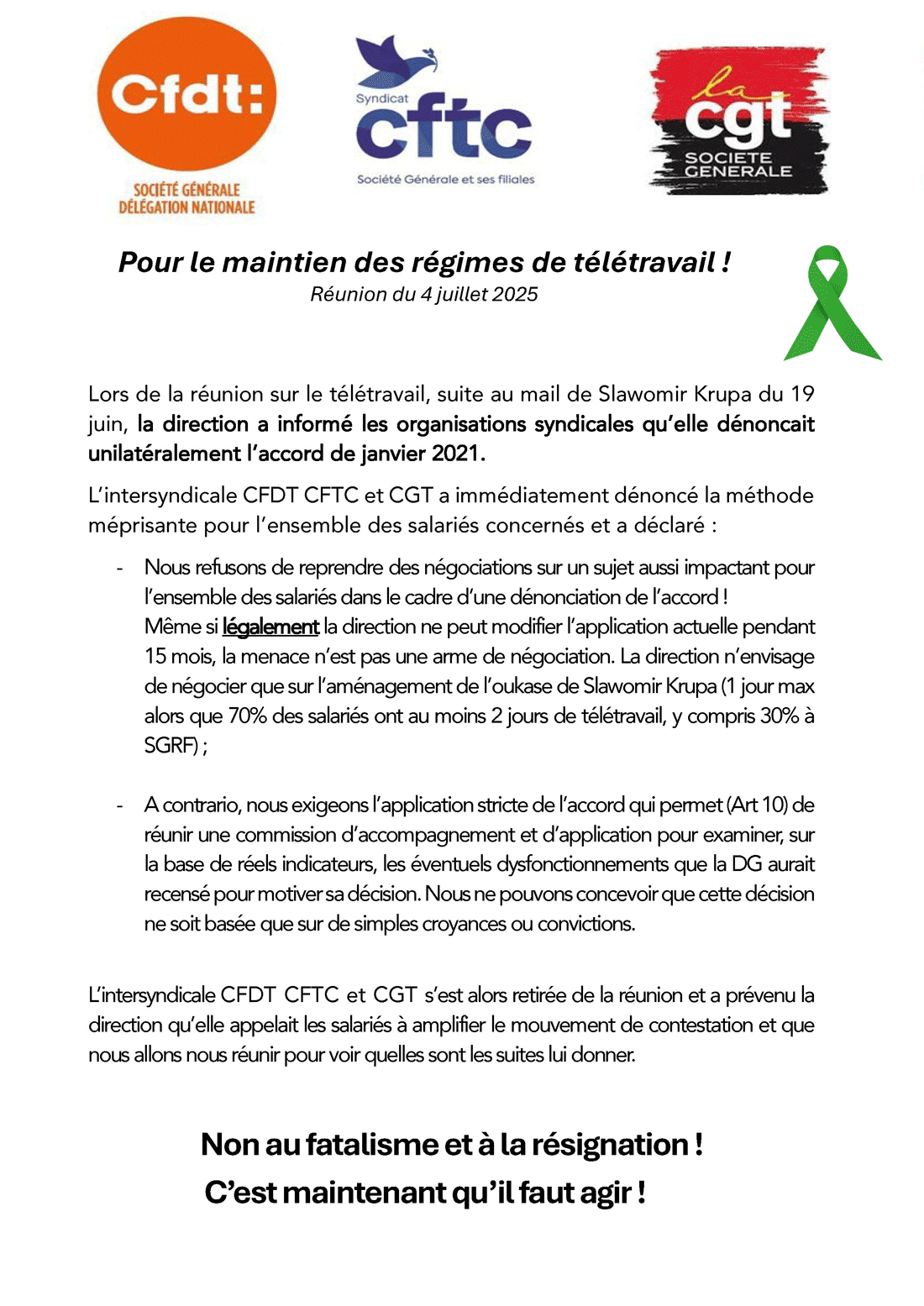
Pour le maintien des régimes de télétravail ! Réunion du 4 juillet 2025
Lors de la réunion sur le télétravail, suite au mail de Slawomir Krupa du 19 juin, la direction a informé les organisations syndicales qu’elle dénoncait unilatéralement l’accord de janvier 2021.
L’intersyndicale CFDT CFTC et CGT a immédiatement dénoncé la méthode méprisante pour l’ensemble des salariés concernés et a déclaré :
Nous refusons de reprendre des négociations sur un sujet aussi impactant pour l’ensemble des salariés dans le cadre d’une dénonciation de l’accord !
Même si légalement la direction ne peut modifier l’application actuelle pendant 15 mois, la menace n’est pas une arme de négociation. La direction n’envisage de négocier que sur l’aménagement de l’oukase de Slawomir Krupa (1 jour max alors que 70% des salariés ont au moins 2 jours de télétravail, y compris 30% à SGRF) ;
A contrario, nous exigeons l’application stricte de l’accord qui permet (Art 10) de réunir une commission d’accompagnement et d’application pour examiner, sur la base de réels indicateurs, les éventuels dysfonctionnements que la DG aurait recensé pour motiver sa décision. Nous ne pouvons concevoir que cette décision ne soit basée que sur de simples croyances ou convictions.
L’intersyndicale CFDT CFTC et CGT s’est alors retirée de la réunion et a prévenu la direction qu’elle appelait les salariés à amplifier le mouvement de contestation et que nous allons nous réunir pour voir quelles sont les suites lui donner.
Non au fatalisme et à la résignation ! C’est maintenant qu’il faut agir !
En ce qui concerne la propension à vouloir démissionner, l’article de Mc Kinsey ci dessous souligne qu’il est globalement à peu près identique quel que soit le mode d’organisation du travail mais qu’il varie surtout en fonction de l’âge. Les plus jeunes sont les plus enclins à quitter l’entreprise, et ce sont aussi les plus attachés au mode de travail hybride (2 ou 3 jours de télétravail). Conclusion : la politique RH de la SG étant officiellement de retenir les jeunes talents, ce serait vraiment idiot de revenir à minimum 4 jours de présentiel puisque cela les fait fuir !
Notons également que McKinsey souligne que ce n’est pas le mode d’organisation de la semaine qui fait la satisfaction et l’efficacité des salariés mais 5 méthodes de travail essentielles (key working practices en VO : collaboration, connectivité, innovation, mentoring et développement des capacités). Et l’étude montre que c’est l’organisation de travail hybride qui obtient les meilleurs scores sur ces 5 points (qui sont ceux mis en avant pour un retour au présentiel). En revanche, l’article souligne également que l’excellence dans ces domaines ne tombe pas du ciel et que c’est à l’entreprise de mettre en place les moyens pour que cela marche. D’une manière un peu ironique, l’article note un fossé entre la perception du top management et celle des employés. Après vient du blabla sur comment réaligner les perceptions, mais le point à mettre en avant c’est que l’autoritarisme du top management peut nuire à la souplesse de l’organisation, à l’engagement et donc à la productivité. C’est écrit dans l’article de McKinsey (sauf autoritarisme) !
Et comme l’article est d’abord orienté vers la question du retour en présentiel, il conclut en soulignant que l’entreprise doit faire en sorte que les avantages de ce retour soient évidents pour les salariés. Cela passe notamment par un environnement adapté avec suffisamment de places, de salles de réunion, d’endroits calmes pour se concentrer… tout ce qui manque actuellement dans les locaux de la SG. Enfin, dernier point qui concerne la SG, l’article insiste sur le rôle des managers dans l’humanisation de l’organisation et note au passage que c’est difficile en période de diminution des couches managériales…
McKinsey Quarterly
Returning to the office? Focus more on practices and less on the policy
February 14, 2025 | Article
The working model is far less important than the work environment leaders create. Five core practices can help organizations implement a policy that best fits their culture.
The world of work is still in flux as many companies continue to follow hybrid and work-from-home models. At the same time, Fortune 500 companies such as Amazon, JP Morgan Chase, and Nike moved to mandated in-office policies of at least four days a week in 2024, and more organizations, as well as much of the US federal workforce, are following suit this year.1
Which working model is best for organizational performance? There is a general debate about whether return-to-office (RTO) policies are too strict, not strict enough, or just right. Our new data suggest this focuses on the wrong question. The policy mandate itself is far less important than the work environment organizations create and the practices that accompany a policy’s implementation. Companies that hope to reach their stated organizational-effectiveness goals should look beyond RTO policies themselves to address the chronic problems that continue to take a toll on employee experience and productivity.
In a new survey of several thousand US employees across industries, most people in each of our tested models (in person, hybrid, and remote) say their overall work experience needs improvement, even if their work arrangement is satisfactory.
In fact, respondents across working models say their organizations are doing a poor job of supporting five core practices that drive performance and strengthen organizational health: collaboration, connectivity, innovation, mentorship, and skill development. Leaders frequently cite these practices as top reasons for getting their people back in the office.
However, the research also shows that leaders have a much more optimistic view of how well their organizations support these five practices, which indicates that they might not be focusing on the core problem. In this article, we explore why embedding and strengthening these practices into the organization can help fuel performance and organizational health, no matter which working model leaders choose.
More organizations are mandating and enforcing RTO
Our latest talent trends research, based on surveys of thousands of employees and employers across industries in the United States (see sidebar, “Our methodology”), shows that there was a surge in RTO across industries from 2023 to 2024.
The proportion of mostly in-person workers (that is, working in person at least four days a week) doubled between our two samples to 68 percent, from 34 percent. The number of workers in a mostly remote arrangement (working remotely at least four days a week) plunged by more than half to 17 percent, from 44 percent, while the number of workers in a hybrid format (working in person two to three days a week) declined to 14 percent, from 22 percent (Exhibit 1).
Exhibit 1
We strive to provide individuals with disabilities equal access to our website. If you would like information about this content we will be happy to work with you. Please email us at: Cette adresse e-mail est protégée contre les robots spammeurs. Vous devez activer le JavaScript pour la visualiser.
The working model won’t automatically improve outcomes
We tested the perceptions of employees who work mostly in person, hybrid, or mostly remote, as well as the relationship between the working model and certain outcomes related to productivity.
The results show that there is no clear winner when it comes to a working model that provides a high level of employee experience and productivity. In-person, remote, and hybrid workers all report mostly similar levels of intent to quit, burnout, effort, and satisfaction. This pattern largely holds true regardless of gender, though there are slight differences across generations and caregiving status.
Most employees in each model report being satisfied or very satisfied with their working-model arrangement. (It’s important to note that satisfaction may stem from the fact that many companies have already sorted their employees—or employees have sorted themselves—into working models.) For models with an in-person component, either hybrid or mostly in person, nearly eight out of ten workers are satisfied with this arrangement, compared with roughly nine out of ten remote workers.
Moreover, the number of employees who want to switch working models is generally low. Both remote workers and workers who are mostly in person report similarly low levels of wanting to switch, at 19 percent. That percentage is much lower than hybrid workers, about one-third of whom say they would like to switch to a different working model.
This is all pretty good news for organizations. However, nagging levels of employee dissatisfaction are still evident—and the working model isn’t solving the problem. Despite employees being satisfied with the working model and having low levels of wanting to switch, some of the leading workforce metrics are trending in the wrong direction across all models.
For example, overall intention to leave is 39 percent, which is comparable to the pandemic high of 40 percent during the Great Attrition. Intention to leave is also similar across working models, ranging from 38 percent (in person and hybrid) to 41 percent (remote). This pattern looks slightly different across groups. Baby boomers across working models have a lower intention to leave (21 to 26 percent) compared with Generation Z, which has a higher intention to leave, particularly for in-person and remote roles (45 percent and 51 percent, respectively).
Women report a slightly lower intention to leave than men across all working models. Noncaregivers report a lower intention to leave than caregivers across models (30 to 34 percent), which may be partly due to the additional responsibilities caregivers have outside of work.
Regarding employee perceptions of whether they are meeting their supervisors’ performance expectations, in-person workers are more likely to believe they are exceeding expectations (25 percent), whereas hybrid workers are least likely (15 percent). This pattern holds true across gender, caregiver status, and most generation groups (with the exception of Gen Z employees, whose perceptions of exceeding their supervisors’ expectations are consistent across all three models).
The amount of effort that employees report putting into their work is similar across hybrid and remote workers and slightly higher for in-person employees: 34 percent of in-person workers strongly agree that they put substantial effort into their work and consistently stay focused while working, whereas 29 percent of remote and 28 percent of hybrid workers say the same. This pattern holds true across gender, caregiver status, and all generation groups except for Gen Z, a cohort whose hybrid workers report slightly higher effort than the other working models.
This finding is important because although effort is linked to individual performance, one person’s extra effort can also raise the game of an entire group. Increased collective effort can have a positive impact on helping peers and mentoring newer colleagues, which are important activities for the healthy social fabric of an organization and can accelerate the timeline by which new joiners are fully productive in their roles.
Finally, roughly one-third of all the workers we surveyed report experiencing burnout (36 percent of remote workers, 35 percent of in-person employees, and 28 percent of hybrid workers). These high levels of burnout (defined as a chronic imbalance between job demands and job resources) should worry leaders, particularly because these levels are higher than the global average seen throughout the pandemic, especially for remote workers.
Burnout is related to several other outcomes. For example, we found a significant positive correlation between burnout and intention to leave, as well as a significant negative correlation between the effort workers put into their roles and their perceptions of meeting supervisors’ performance expectations. In many cases, burnout is related to navigating a high-stress environment with poor levels of collaboration, mentorship, and the other key working practices that elevate experience and engagement.
Five key practices: How are companies doing?
Our research shows that employees’ satisfaction across working models is, on average, moderate but that employee experience and productivity rates are relatively lower. To dig deeper into why, we tested five core practices that our research shows spur organizational health and that were the most frequently stated reasons leaders gave for transitioning to RTO: collaboration, connectivity, innovation, mentorship, and skill development.
The data show that across working models, most employees perceive relatively low organizational maturity across these five key practices (though hybrid models score a little higher). Aside from connectivity, roughly half or fewer of respondents in each model rate levels of collaboration, innovation, mentorship, and skill development as effective at their organizations, which has both direct and indirect implications for performance (Exhibit 2).
Exhibit 2
We strive to provide individuals with disabilities equal access to our website. If you would like information about this content we will be happy to work with you. Please email us at: Cette adresse e-mail est protégée contre les robots spammeurs. Vous devez activer le JavaScript pour la visualiser.
This means that changing the working model alone will not resolve or even change the nature of the problem unless organizations address why their employees feel this way.
Complicating the path to a solution, there is a disconnect between leaders and employees when it comes to evaluating the effectiveness and maturity of these five practices in each working model. Leaders’ views of average maturity across practices are much higher than the views of employees in each model (Exhibit 3).
Exhibit 3
We strive to provide individuals with disabilities equal access to our website. If you would like information about this content we will be happy to work with you. Please email us at: Cette adresse e-mail est protégée contre les robots spammeurs. Vous devez activer le JavaScript pour la visualiser.
For example, 90 percent of surveyed leaders view connectivity as a mature and well-functioning practice, while only 67 percent of employees view it positively.
What may account for such a big gap in experience? Senior leaders have the skill, experience, strategic perspective, and autonomy to shape their own working model and collaboration pattern in a way that is optimal for them and the senior-executive teams they are a part of. And at that level, they are not beholden to scalable business processes, management practices, collaboration mechanisms, and enabling technologies to make the model work.
However, the larger organization often lacks the capabilities, empowerment, and enabling support mechanisms to achieve something nearly as effective as what most senior executives experience. This lived work experience creates a chasm in many organizations, harming the work environment, engagement, and, ultimately, performance. The first step is acknowledging that this problem exists.
The enablers: Behaviors and other key factors
After acknowledging the problem, leaders can look for concrete ways to strengthen the practices. Our research shows that each working practice has behaviors, policies, or norms that contribute to how well it functions. Some of these enablers, as we call them, are more important than others, and together they influence the maturity of each practice, regardless of working model (Exhibit 4).
Exhibit 4
We strive to provide individuals with disabilities equal access to our website. If you would like information about this content we will be happy to work with you. Please email us at: Cette adresse e-mail est protégée contre les robots spammeurs. Vous devez activer le JavaScript pour la visualiser.
These enablers reflect the dynamics that are present in each model, including commonalities and differences in experience. Overall, all five working practices share at least two enablers across each of the working models, suggesting that what organizations need to get right is largely the same, allowing for nuances related to the working model.
Building (or restoring) the foundation of a high-performing organization
When it comes to collaboration, goal alignment (having clear and shared objectives across the team) is the most influential factor across all working models. Regardless of model, leaders and managers should regularly clarify priorities and connect the dots on how work fits together. This includes aligning on the right partnerships within and across teams and tying the work to the broader strategic objectives of the company.
Effective collaboration requires a combination of formal weekly or biweekly check-ins and targeted one-on-one time. It can be enhanced with digital enablement tools such as a shared brainstorming workspace. With in-person and hybrid models, collaboration can mean a combination of formal and informal face time; remote work may demand a more formalized approach.
Connectivity
Organizations face the task of reconstructing workers’ largely individual realities into a shared reality. They should be able to clearly communicate answers to key questions: Why is it important that we come together? What is the ideal frequency for being in the office? How do we balance time for connectivity with “heads down” work?
Communication is foundational for restoring connectivity. The cadence of communication and the messaging behind the “why” of in-person work requirements is crucial. From the CEO to frontline supervisors, managers must offer a transparent rationale for the time spent in person, because this expectation is no longer the widespread norm. If leaders choose an RTO mandate, they should apply it consistently, following commonsense principles and using appropriate exceptions.
Communication is necessary, but insufficient by itself. Leaders must follow through to ensure that the expectations around the “why” come to fruition in the day-to-day.
If workers are on the same page because the organization engages them in the communications part of change management, they are less likely to resist mindset and behavior shifts. Employees aren’t unhappy working in person, as our data show, but they may need time and support to evolve to new norms.
For connectivity, one of the most important enablers for all working models is leadership connection. This means leaders must carve out time to be visible and available for their teams, regardless of the model. Physically being in the same office but stuck on back-to-back calls does not create a leadership connection.
Managers can proactively block time in their calendars for coffee chats, one-on-ones, and skip-level meetings (virtual or in-person). They can regularly spend time outside their office with on-site visits or “ride-alongs.” If in person, they can make sure that time on their calendar is protected for impromptu working sessions and social activities such as lunch and happy hour. Many of these practices were routine before the pandemic, but we have seen, anecdotally, that both managers and employees are out of practice with respect to some core connectivity behaviors.
While an innovative culture and the presence of psychological safety are essential for innovation in every model, remote workers require additional leadership support, including guidance and guardrails on the tasks at hand but also to secure buy-in or funding from other leaders.
For in-person workers, a “failing fast” culture that embraces experimentation and iteration is essential. In-person workers must be able to engage in discussion and healthy feedback with colleagues and leaders to test ideas and learn from shortfalls through structured after-action reviews.
For hybrid workers who are navigating a combination of synchronous and asynchronous work, transparency and trust with both leaders and peers play key roles in spurring innovation.
Mentorship
Across all working models, a combination of formal programs and informal peer coaching is necessary for effective mentorship. For hybrid and remote workers, clear coaching expectations are a key enabler to high-quality mentorship. In-person employees, on the other hand, expect more mentorship from leaders and peers since they are in the office together.
There is a real opportunity to use data and technology to increase the effectiveness of formal mentorship programs—for example, by leveraging generative AI to give mentors the tools, nudges, and coaching they need to be more effective. AI can be used to better match mentors and mentees or tease out the unique factors that drive better mentoring relationships.
Informal peer coaching and coaching expectations can be enhanced in every working model when organizations redesign roles to allow for mentorship and people leadership more broadly. This includes sharing guidance on what great looks like in terms of time commitment and cadence. Annual performance reviews can evaluate how engaged leaders and managers are in people leadership and mentorship and can be an effective way to increase accountability.
Finally, our research into employees’ perceived effort shows that higher levels of perceived effort may positively affect supportive behaviors in the workplace. For example, caregivers, younger workers, and in-person and hybrid workers report spending more time mentoring and coaching new joiners. These behaviors can affect colleagues’ productivity and can help maintain or restore an organization’s social fabric.
Indeed, if a chief reason for spending more time working in person is to preserve culture, these are productive activities and valuable behaviors that resonate beyond role responsibilities.
Skill development
Effective skill development is largely driven by resources—namely, how much the company invests in opportunities for learning. While this likely includes training across functional and technical skills, as well as adaptive and leadership skills, training is only one piece of the puzzle.
Cutting-edge organizations are investing time and resources into reskilling and upskilling key groups through virtual coaching (including avatar-based coaching and virtual reality tools), boot camps, partnerships with organizations offering certifications, and bite-size learning and nudges. They are also investing in apprenticeships, job rotations, and flexible career paths.
Beyond the opportunity and resources to learn new skills, a combination of leader reinforcement and peer support is critical to ensuring that teams can carve out time to engage in learning opportunities.
Leaders can also ensure that upon completing these reskilling and upskilling programs, employees can practice and apply their new skills. Workers should also receive regular feedback and coaching on the new skills; since this is less common in hybrid and remote settings, leaders should be more intentional about it.
A primary reason to return to the office is to be together in person doing work that is less effectively done virtually, including certain kinds of collaboration, connectivity, culture building, and skill building. If leaders are going to mandate that people come into the office, they should maximize the upside of the activities and practices that deliver on the promise of co-locating with colleagues.
Complement RTO policies with the practices that create a healthier and more collaborative organizational culture. Conducting an organizational-health assessment is a great way to understand strengths and weaknesses and build a plan to address them.
Shape the physical environment to meet workforce needs. Make sure the space is set up to support in-person work, with enough seats and strong Wi-Fi. Leverage smart-room technology to help with scheduling meetings. In addition to available meeting spaces and huddle rooms, make sure people have enough private space to do their heads-down work.
Spend focused time with team members. This is true whether a company’s working model is fully in person, hybrid, or remote. This can be challenging because of the pressure put on managers and may be exacerbated by cuts to management ranks. That said, spending time with team members helps with mentorship, skill development, and leadership connectivity.
Design the workweek with a combination of individual time, deliberate collaboration within teams, and cross-team connections, with clear goals for each set of time. The key is to plan when things are going to happen, not just assume they will. This approach can help with connectivity, collaboration, and innovation.
Regularly take stock of what is working well and what isn’t across the model. It is unlikely that any individual team or leader will be perfect off the bat during a shift in work arrangements.
Employees
Make the most of in-person time by scheduling regular check-ins with managers, function leaders, and others. Don’t slip into the habit of joining calls by video when everyone is in the building.
Embrace the increased connectivity but be mindful of the individual work that needs to get done. A learning mindset is crucial here, and workers will likely need to modify some habits. Align with managers on the right way to get quiet time. Having authentic conversations about personal constraints and team norms is the best way to jointly problem-solve and achieve the best outcomes.
To improve performance, leaders must reestablish the underlying practices that drive organizational health and performance, then choose the working model that best fits their culture. Organizations that do so can reap the rewards of productivity, engagement, and employee satisfaction—no matter where people work.
This article has been updated to further explain our methodology.
We strive to provide individuals with disabilities equal access to our website. If you would like information about this content we will be happy to work with you. Please email us at: Cette adresse e-mail est protégée contre les robots spammeurs. Vous devez activer le JavaScript pour la visualiser.
We are celebrating the 60th birthday of the McKinsey Quarterly with a yearlong campaign featuring four issues on major themes related to the future of business and society, as well as related interactives, collections from the magazine’s archives, and more. This article will appear in the third themed issue, on the Future of Growth, which will launch in May. Sign up for the McKinsey Quarterly alert list to be notified as soon as other new Quarterly articles are published.
How relevant and useful is this article for you?
About the author(s)
Aaron De Smet is a senior partner in McKinsey’s New Jersey office; Brooke Weddle is a senior partner in the Washington, DC, office, where Bryan Hancock is a partner; Marino Mugayar-Baldocchi is a research science expert in the Miami office; and Taylor Lauricella is an expert associate partner in the New York office.
The authors wish to thank Crystal Zhu and Yueyang Chen for their contributions to this article.
This article was edited by Barbara Tierney, a senior editor in the New York office.